
Tree Removal in Canton, SD | Safe Removal Work
Canton sits in the rolling hills of the Sioux Valley. The Big Sioux River runs along its east edge. Many homes date back to the late 1800s. That mix of slopes, old trees, and old streets makes safety the first thing to plan on any removal. Sioux Falls Elite Tree Care treats each job as a safety job. That runs from how we mark off the work area to how each limb comes down and where the wood ends up.
We remove trees across town. Jobs range from older homes near the courthouse to hillside lots and acreages outside city limits. Before work starts, we walk the property with you. We point out any hazards we see. We explain how the tree will come down without putting people, cars, or buildings at risk. Request a quote, and we will set up a time to take a look.
Frequently Asked Questions
How much does tree removal cost?
Most single removals land between $250 and $2,000. A typical mid-size tree, about 45 feet, runs about $495 to $788 with standard access. Small trees cost less. Large trees near a house or power lines cost more. We give you a firm price in writing before we start.
Do you grind the stump too?
Yes. We can grind the stump on the same visit or on a later day. Grinding cuts the stump about 12 inches below the ground. Most single stumps cost $120 to $400 based on size.
How long does a tree job take?
A small removal takes a few hours. A mid-size removal takes half a day to one full day. Trimming most homes takes half a day. We clean up and haul debris the same day.
Will you try to save my tree first?
Yes. If a tree can be trimmed, pruned, or braced and stay safe, we will tell you. We only push removal when the tree is dead, split, or a real risk to your home.
What should I do after a storm?
Stay clear of hung limbs and downed lines. Take photos from a safe spot. Then send us the estimate form. We handle storm cleanup and can take down split or leaning trees fast.
Do you clean up when you finish?
Yes. We haul limbs, wood, and brush. We rake the work area. Your yard should look clean when we leave.
What Does My Tree Project Cost?
Tree work is priced per tree, by size — removal and trimming by height, stump grinding by the inch of stump width. Here are the ranges we see on real jobs around Sioux Falls, and a calculator built on the same numbers.
Tree Removal
A typical mid-size tree — about 45 feet — runs about $495–$788 around Sioux Falls with standard access; most single removals land between $250 and $2,000. A tree that has to be roped down in pieces over a roof runs higher, and a crane day adds $500 to $2,500 that no online range can fold in sight unseen — crane jobs are priced in person from this range as the base. Stump grinding is priced separately — see Stump Grinding.
Tree Trimming & Pruning
A typical 45-foot shade tree runs about $405–$720 to trim around Sioux Falls; most trimming visits land between $150 and $1,200. Shrubs and small ornamental trees are priced with the visit at the in-person estimate — they ride along on trimming jobs rather than pricing as their own service.
Stump Grinding
Most single stumps run $120–$400 around Sioux Falls — there's a minimum charge to bring the grinder out, and past about 30 inches the price follows the diameter. Below that size the minimum, not the inches, is most of the price; that's how published stump pricing works, not a calculator error. Extra stumps on one visit are usually discounted per stump in person. Grindings are left in the hole unless haul-off is arranged at the estimate.
Emergency & Storm-Damage Removal
A storm-damaged mid-size tree that can't wait runs about $765–$1,260 around Sioux Falls on a priority daytime response; a tree on the house is priced on site. Two cases route differently. A tree already down in an open yard that hit nothing is not an emergency job. It prices at or below the Tree Removal range. A tree on a house that needs a crane is quoted on its own. This range is the starting point for that quote, not the quote itself.
Lot Clearing & Brush Removal
Clearing a typical half-acre building lot with moderate growth runs about $1,150–$1,950 around Sioux Falls; per acre, figure $1,100–$7,000 depending on what's growing. The base price figures trees and brush cut and mulched or chipped on site, stumps cut flush — not ground out — and no grading, excavation, or permits.
What Moves the Price
- Height. Removal and trimming price by the foot of height — a 70-foot oak is more wood, more rigging, and more crew hours per foot than a 25-foot ornamental, and the per-foot rate rises with the tree.
- What's under the tree. A tree in the open drops in big pieces. The same tree over a roof, fence, or dock comes down roped, one piece at a time — published estimating practice puts rigged work at 1.3 to 2 times the ground labor.
- Dead or storm-damaged wood. A dead, leaning, or split tree can't always be climbed safely and cuts unpredictably — hazard work runs 20 to 50 percent over a healthy tree of the same size.
- The stump is its own job. Grinding prices per inch of diameter with a minimum charge to bring the grinder out, which is why a small stump costs close to a medium one — and why grinding is quoted separately from removal.
- Season. Summer and fall storm season is peak demand; the same removal can run 10 to 20 percent higher then than in winter.
Where these numbers come from. Published national cost guides — Angi, HomeGuide, and Lawn Love project data — guide these numbers. We adjusted them to Sioux Falls with Bureau of Economic Analysis price levels. The Sioux Falls metro runs about 7% under the Charlotte metro. We also used BLS wage data for South Dakota tree trimmers. We checked the results against Sioux Falls marketplace averages. They're planning ranges, not a quote.
A note on how the work gets done. These ranges figure a tree taken down by a climber or a bucket truck — whichever can reach it — with the brush chipped and hauled away and the stump left cut flush at the ground. Two things can move you within the range, or a little past it. The first is the tree itself: a thick hardwood like oak or hickory is heavier, harder on saws and grinders, and slower to haul than a pine the same height, and a trunk much over two feet across prices like a bigger tree than its height suggests. The second is the method. A tree may be dead, split, or boxed in over a roof. It can't be climbed or reached by a bucket. A tree like that may need a crane. A crane day adds $500 to $2,500. No online range can fold that in sight unseen. Leaving the trunk wood for firewood instead of hauling it can bring the price down. Tell us what's standing and what's under it, and we'll confirm the method and the exact price at the in-person estimate, before any work starts.
Estimate Your Project
Best guess is fine — measure the shadow on a sunny day or compare to the house (about 10 ft per story).
Several trees in one visit usually price lower per tree in person — this estimate doesn't take that discount.
Stump grinding is priced separately — see Stump Grinding.
Shrubs and small ornamentals price with the visit at the in-person estimate.
Measure across the widest point at ground level, including the root flare where the trunk spreads into the ground.
Grindings are left in the hole unless haul-off is arranged at the estimate.
If the tree is already down in an open yard and hit nothing, price it under Tree Removal instead — down trees cost less, not more.
A typical building lot is a quarter to a half acre.
Stumps are cut flush, not ground out; grading and permits are separate.
Free — no obligation. Your calculator numbers ride along with the request.
Send Your Project to Sioux Falls Elite Tree Care
Your estimate is attached automatically. Add your info and — if you can — a few photos of the tree or lot. Photos help us price the job before we ever set foot in the yard.
Safe, Efficient, and Precise Tree Extraction
Contact Form
Why Canton Homeowners Feel Safe Calling Us
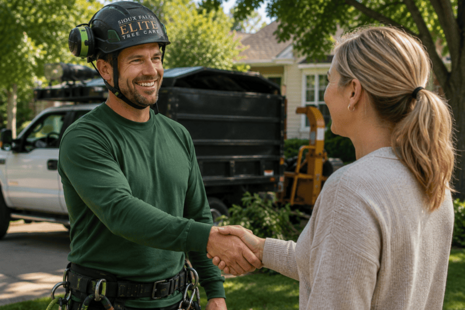
Sioux Falls Elite Tree Care is based in Sioux Falls, about 18 miles north of Canton. Each job starts with a safety plan. The crew marks off the work zone before the first cut. No one stands under a limb while it is being worked on. If the wind picks up, or the wood acts in a way we did not expect, the crew stops. They check the plan before they go on. A removal may take a bit longer this way. It ends with everyone and everything unharmed. That is the only kind worth doing.
Norwegian Roots and a County Seat on the Big Sioux
Lewis P. Hyde was the first known visitor to the area in 1866. August Linderman became its first settler. Residents named the town Canton. They believed it sat right across the globe from Canton, China. Credit for the name goes to James M. Wahl, a Norwegian settler and later legislator. In the summer of 1868, a caravan of 180 Norwegian settlers crossed the Big Sioux River to make their homes here. The railroad followed in 1880. Canton is the seat of Lincoln County. It grew into a center of civic life. Town landmarks still stand today. They include the 1889 Lincoln County Courthouse, the 1886 Historical Society House, the Kennedy Mansion on Dakota Street, and the 1908 Canton Lutheran Church.
The town also left a mark far beyond its size. Augustana College moved here from Beloit, Iowa, in 1884. The school built alongside it educated Ernest Lawrence. He won a Nobel prize and invented the cyclotron. Ole Rølvaag, author of Giants in the Earth, graduated from what became Augustana Academy. In winter, a hill east of town drew huge crowds for ski jumping. The Sioux Valley Ski Club hosted the national tournament in 1925. More than 10,000 fans came. The club held the 1932 U.S. Olympic ski jumping trials. It drew an estimated 15,000 to 20,000 people in 1935. You can still see the old site near a historic marker on U.S. Highway 18, two miles east of town.
Slopes, Sidewalks, and Safe Work Zones in Canton
Many properties around town sit on sloped ground. Slopes change how a removal must be handled. A log that stays put on flat grass can roll downhill. It can roll toward a house, a fence, or the street. So we cut trunk sections into shorter rounds. We block them in place before we move them. We choose the drop direction with the slope in mind. We check footing before anyone works on uneven ground. Gear stays where the ground is stable. On a steep yard, it often makes more sense to lower pieces on ropes. Then nothing falls free at all.
Trees along streets and sidewalks bring a different risk. In the older parts of town, mature trees often stand close to the curb. People on foot, parked cars, and passing traffic are just a few feet away. For those jobs, we mark off a work zone before the first cut. A spotter on the ground stops anyone from walking into it. We plan the cuts so wood comes down inside the marked area. If a car needs to move, or a neighbor should know about the work, we tell you ahead of time. That way the day gets off to a smooth start.
Cold Winters, Frost Cracks, and Peace of Mind
The area falls in USDA Plant Hardiness Zone 4b. It averages about 25 nights a year below zero. That kind of cold leaves marks on trees. Frost cracks are long splits that run up the trunk. They open when bark warmed by winter sun cools fast after dark. They show up most often on the south and southwest sides of thin-barked trees like maples and lindens. Some cracks close over. Others reopen year after year and let decay in. At the estimate, we check for these cracks. We also check for dead limbs and hollow spots. A tree with a deep crack can fail in ways that change how it should come down.
This is an established community. The median age is near 39. Almost one in five residents is 65 or older. For many homeowners, the safest removal is one they do not have to take part in. You should not have to drag branches to the curb. You should not have to stack heavy rounds. You should not have to climb a ladder to deal with what is left. We handle each part of the job. That runs from the first cut to hauling away the last of the brush. We explain each step in plain terms. You always know what is happening on your property.
Our Safety-First Removal Process
Step 1: Request a Quote
Tell us what's going on with the tree and the best times to reach you.
Step 2: Property Walkthrough
We look over the tree, its surroundings, and the best route in and out for the crew.
Step 3: Straightforward Pricing
Your written quote lists the full scope, and that price holds unless the scope changes.
Step 4: Confirmed Schedule
We book a date that works for you and confirm it again before the crew heads out.
Step 5: Removal Work
The crew brings the tree down in the planned order, keeping everything around it protected.
Step 6: Stump and Roots
If grinding is included, we take the stump down and talk through any roots near concrete.
Step 7: Cleanup and Sign-Off
We haul away debris, leave the site tidy, and make sure you're satisfied before we go.
Request a Quote From Sioux Falls Elite Tree Care
A leaning tree near the house, a dead limb hanging over the fence, or a fast-growing tree that has outgrown its spot is easier to handle before it turns into a bigger problem. We'll come out, look at the tree in person, and explain your options before anything goes on the schedule.
Request a quote and we'll set a time to walk the property with you. If a tree has already come down or looks ready to, check availability and we'll get back to you as soon as we can.